


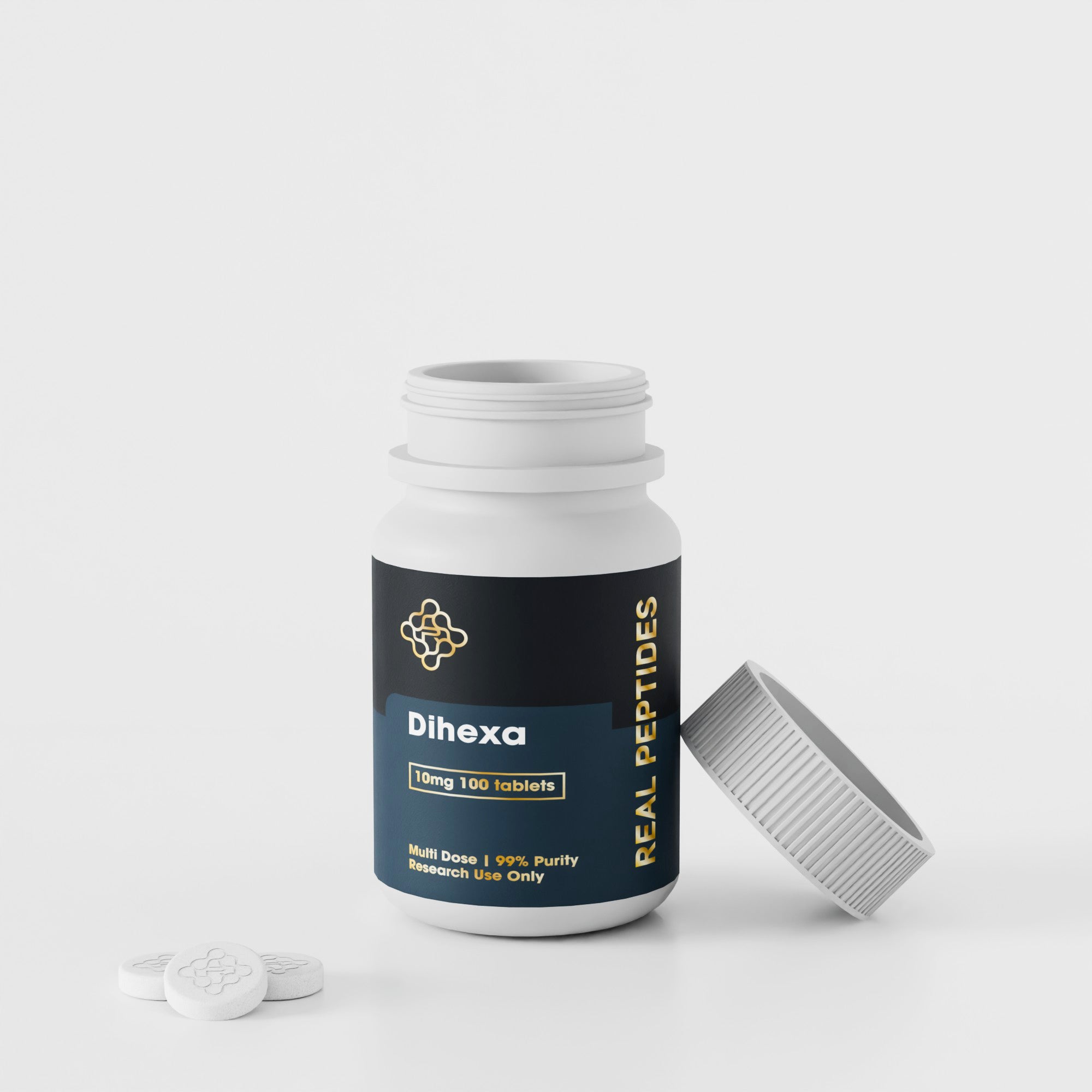
Dihexa Peptide – Advanced Cognitive Research Compound
Dihexa Peptide is an advanced research compound widely studied for its potential role in cognitive enhancement, neuroplasticity, and brain signaling pathways. Researchers investigating memory formation, neural repair, and synaptic communication often examine Dihexa Peptide because of its unique ability to influence pathways associated with brain-derived growth signaling and neuronal connectivity.
In modern neuroscience research, compounds that support neural communication and synaptic formation have become a major focus. The Dihexa Peptide has attracted considerable scientific attention because laboratory investigations suggest that it may activate pathways related to hepatocyte growth factor (HGF) and its receptor system. These pathways are strongly associated with neuronal growth, synapse formation, and cognitive processing.
Unlike many research compounds that influence cognition indirectly through neurotransmitters, Dihexa Peptide works at the level of neuronal signaling networks. This characteristic makes the Dihexa Peptide especially valuable in research environments studying learning mechanisms, memory consolidation, and neurodegenerative processes.
Because of its promising properties, the Dihexa Peptide has become a widely discussed compound in modern brain research. Researchers exploring cognitive disorders, aging-related memory decline, and neural regeneration often investigate Dihexa Peptide as part of broader neuroscience studies.
What Is Dihexa Peptide?
Dihexa Peptide is a synthetic peptide compound derived from modifications of angiotensin IV analog structures. Scientists engineered the Dihexa Peptide to cross the blood-brain barrier effectively, allowing it to interact with neural pathways involved in cognition and neuronal growth.
One of the defining features of Dihexa Peptide is its ability to stimulate signaling pathways associated with hepatocyte growth factor (HGF). These pathways play a critical role in the development and repair of neuronal networks.
Research involving Dihexa Peptide has explored several key neurological processes, including:
-
synapse formation
-
neuronal growth signaling
-
memory consolidation
-
neural connectivity
-
neuroplasticity
Because these processes are fundamental to learning and cognitive performance, Dihexa Peptide has become a valuable research compound in neuroscience laboratories worldwide.
The Science Behind Dihexa Peptide
Understanding how Dihexa Peptide works requires examining the mechanisms involved in neural communication and brain plasticity.
The human brain contains billions of neurons that communicate through specialized connections called synapses. The strength and number of these connections influence cognitive performance, memory storage, and learning ability.
Research suggests that Dihexa Peptide may promote the formation of new synaptic connections through activation of growth signaling pathways.
Synaptogenesis and Dihexa Peptide
Synaptogenesis refers to the creation of new synaptic connections between neurons. These connections allow neurons to transmit signals efficiently and form complex networks responsible for learning and memory.
Studies examining Dihexa Peptide have shown that it may significantly increase synapse formation in experimental models. This increased connectivity may enhance communication between neurons.
For researchers studying cognitive performance, Dihexa Peptide provides a compound capable of influencing neural architecture directly.
Neuroplasticity and Cognitive Adaptation
Neuroplasticity is the brain’s ability to reorganize itself by forming new neural connections. This process allows the brain to adapt to new experiences, recover from injury, and store memories.
The Dihexa Peptide is frequently investigated for its potential role in supporting neuroplasticity. By activating signaling pathways involved in neuronal growth, Dihexa Peptide may help researchers understand how the brain adapts and evolves over time.
Key Features of Dihexa Peptide Tablets
The Dihexa Peptide tablets used in research environments are designed to offer several advantages for laboratory study.
Blood-Brain Barrier Penetration
One of the most important characteristics of Dihexa Peptide is its ability to cross the blood-brain barrier efficiently. This allows the compound to reach neural tissue where cognitive processes occur.
Stability in Research Settings
The Dihexa Peptide structure offers improved stability compared to some other peptide compounds, allowing for controlled experimentation.
High Affinity for Growth Signaling Pathways
Studies suggest that Dihexa Peptide interacts strongly with pathways linked to neuronal growth factors.
Potential Research Applications of Dihexa Peptide
Because of its unique properties, Dihexa Peptide is investigated in a wide variety of neuroscience research fields.
Memory and Learning Studies
Researchers studying learning processes often examine Dihexa Peptide because of its potential influence on synaptic connectivity.
In experimental models, compounds that increase synapse formation may improve information processing efficiency.
Neurodegenerative Disease Research
Neurodegenerative disorders are frequently associated with the loss of neurons and synaptic connections.
Laboratory research exploring Dihexa Peptide examines whether enhanced synaptic growth signaling may support neuronal survival and communication.
Brain Injury Research
Traumatic brain injuries can disrupt neural pathways and reduce cognitive performance.
Some researchers investigate Dihexa Peptide in experimental models to better understand how neural growth pathways may support recovery and neural regeneration.
How Dihexa Peptide Influences Brain Signaling
The mechanism of Dihexa Peptide is associated with hepatocyte growth factor (HGF) signaling pathways.
These pathways influence several important biological processes:
-
neuronal survival
-
synaptic formation
-
neural migration
-
tissue repair
By interacting with these signaling systems, Dihexa Peptide may influence how neurons grow and connect with each other.
Dihexa Peptide and Synaptic Density
One of the most frequently discussed research findings related to Dihexa Peptide is its potential ability to significantly increase synaptic density.
Synaptic density refers to the number of synaptic connections within a given neural network.
Higher synaptic density may enhance information processing and cognitive function.
Because of this property, Dihexa Peptide has become an important compound in studies examining cognitive performance and neural connectivity.
Comparison with Other Cognitive Research Peptides
The Dihexa Peptide differs from many other cognitive research compounds.
Compared to Neurotransmitter Modulators
Some compounds enhance cognition by increasing neurotransmitter levels.
Dihexa Peptide instead focuses on structural changes in neural networks.
Compared to Neurotrophic Peptides
Neurotrophic peptides stimulate neuron survival and growth.
The Dihexa Peptide works through growth factor signaling pathways, which may lead to stronger synaptic networks.
Research Protocols for Dihexa Peptide
Laboratory research involving Dihexa Peptide typically follows carefully controlled experimental protocols.
Researchers may examine the compound using:
-
cellular models
-
animal studies
-
biochemical pathway analysis
These methods allow scientists to observe how Dihexa Peptide influences neural growth, synaptic density, and signaling pathways.
Storage and Stability
Proper storage conditions are essential to maintain the integrity of Dihexa Peptide tablets.
Recommended conditions include:
-
cool and dry environment
-
protection from light
-
sealed containers
These precautions help ensure consistent research results.
Safety and Research Status
The Dihexa Peptide remains primarily a research compound used in scientific investigations.
Researchers should follow appropriate laboratory protocols when handling the compound.
Frequently Asked Questions
What is Dihexa Peptide used for?
Dihexa Peptide is studied in neuroscience research for its potential influence on synaptic growth, memory pathways, and cognitive signaling.
Does Dihexa Peptide cross the blood-brain barrier?
Yes. One of the key features of Dihexa Peptide is its ability to cross the blood-brain barrier, allowing it to interact with neural tissue.
Why is Dihexa Peptide important for neuroscience research?
The Dihexa Peptide may influence neural growth signaling pathways, which are essential for understanding memory, learning, and neuroplasticity.
Conclusion – The Future of Dihexa Peptide Research
The Dihexa Peptide represents one of the most intriguing compounds currently being explored in neuroscience research. Its ability to interact with growth signaling pathways and promote synaptic connectivity makes it a powerful tool for studying brain function and neural plasticity.
As scientific research continues to expand, Dihexa Peptide may help researchers gain deeper insights into how neural networks form, adapt, and support cognitive processes.
By enabling the study of neuronal connectivity and synaptic growth, Dihexa Peptide provides a valuable platform for advancing the understanding of brain function and cognitive science.
Be the first to review “Powerful Dihexa Peptide – Cognitive Enhancing Peptide Tablets for Brain Research”
Related products

Cognitive & Nootropic
BAC Reconstitution Water for Peptides – Bacteriostatic Mixing Solution
Cognitive & Nootropic
Buy DSIP Peptide 5 mg | Sleep-Regulation & Stress-Response Research
Cognitive & Nootropic
Buy ARA-290 Peptide 16 mg | Cibinetide for Inflammation & Tissue-Repair Research
Cognitive & Nootropic
Buy Kisspeptin-10 Peptide 10mg | Reproductive & Neuroendocrine Research

Cognitive & Nootropic
Glutathione Injection – Injectable Supplement Antioxidant Support

Cognitive & Nootropic
Buy Cerebrolysin Peptide | Injections for Neuroprotection & Cognitive Research
Reviews
There are no reviews yet.